For useful social media competitor analysis, choose brands with overlapping buyers, compare one platform over the same dates, and keep recruiting separate from buyer-facing content. Turn source-backed observations into ideas to test, then plan only the posts your team can make. Public likes won't tell you which competitor sells more.
This walkthrough follows a real Okou staging run: Buffer, Metricool and Planoly on LinkedIn, followed by a four-post plan. Open the actual comparison and content plan. Its appendix contains 47 retained posts with dates, visible counters and source links.
The planning business is illustrative: an English-language social scheduling tool. It isn't Okou's business or a customer case. The screenshots are from Okou's staging product on November 23, 2026; the run used real public data, not a simulated response.
1. Choose competitors you could learn from
Start with the buyer's task. Buffer, Planoly and Metricool all offer social media planning or management tools. That gives us a reason to compare their content for a scheduling product. It doesn't make their audiences, budgets or distribution equal.
Choose accounts that meet two conditions:
- They address a similar buyer or recurring business problem.
- They publish on the platform you want to plan for.
A global entertainment account can be useful creative inspiration. It is a poor performance benchmark for a small business selling scheduling software.
Keep this first comparison on LinkedIn. Mixing Instagram views with LinkedIn likes would introduce a second problem before you've answered the first. If your real buyers use Instagram, repeat the exercise there in a separate matrix.
For an individual account's creative choices, use a deeper walkthrough such as analyzing a TikTok account for competitor research. Here, the job is to compare accounts under the same rules and decide what to publish next.
2. Ask the business question in plain language
The actual opening prompt was:
Look at these three LinkedIn pages. What could we post next week for our social scheduling tool?

https://www.linkedin.com/company/bufferapp
https://www.linkedin.com/company/planoly
https://www.linkedin.com/company/metricool
That's enough to start. You don't need to write a research protocol into the message.
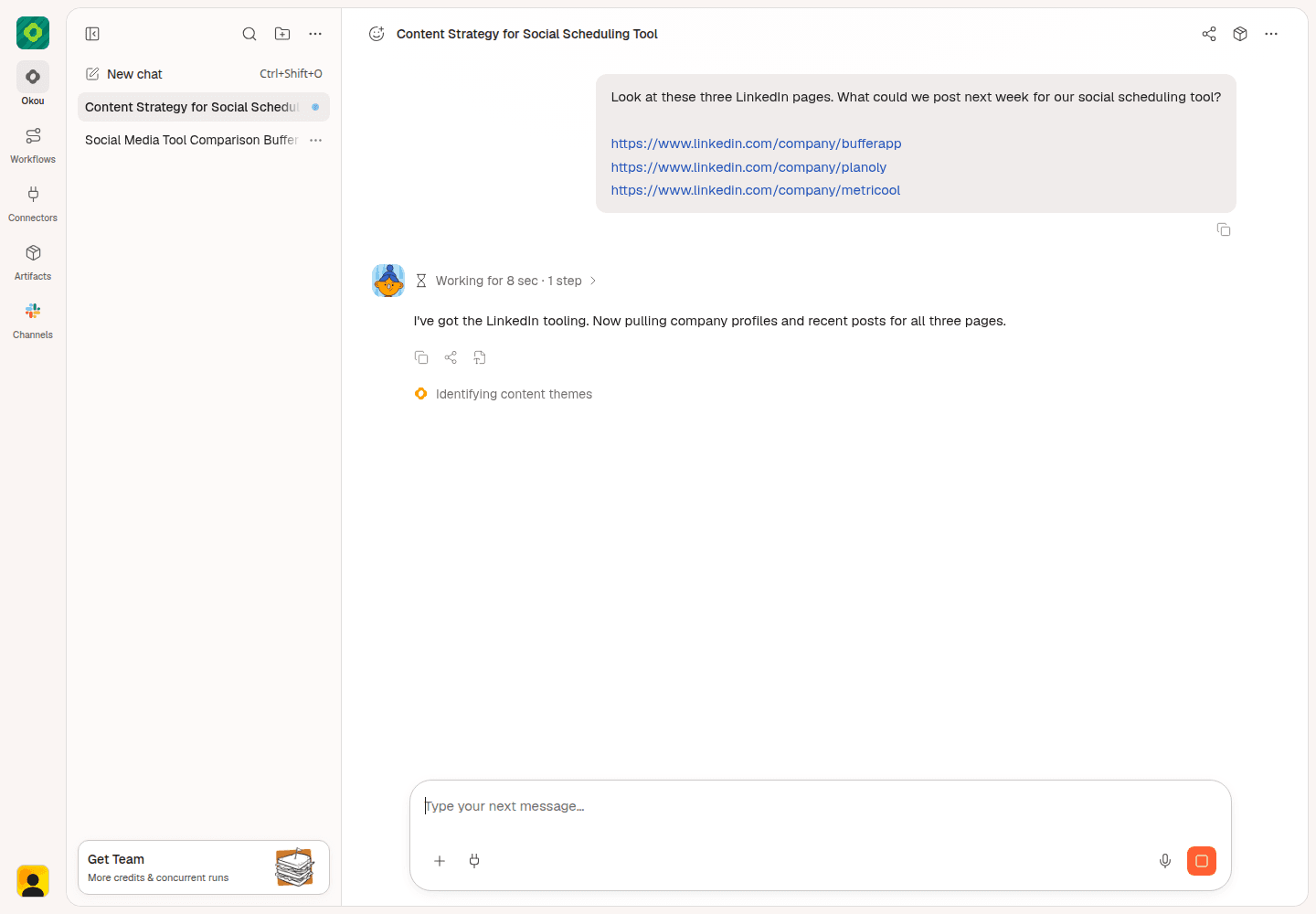
The real opening prompt and Okou's first research step. No long brief or prepared dataset was supplied to this fresh chat.
Okou retrieved public company-post data. Planoly's first feed request returned empty, so the run retried it. That matters: an empty response isn't evidence that a company has stopped posting.
The first answer proposed a five-day plan and used rolling recent-post samples. Useful starting material, but not yet a fair comparison or a plan matched to our capacity.
3. Give the comparison a common window
The next actual message was:
Use November 9–22 for all three and make it two posts a week. Put the comparison and two-week plan on a page I can share.
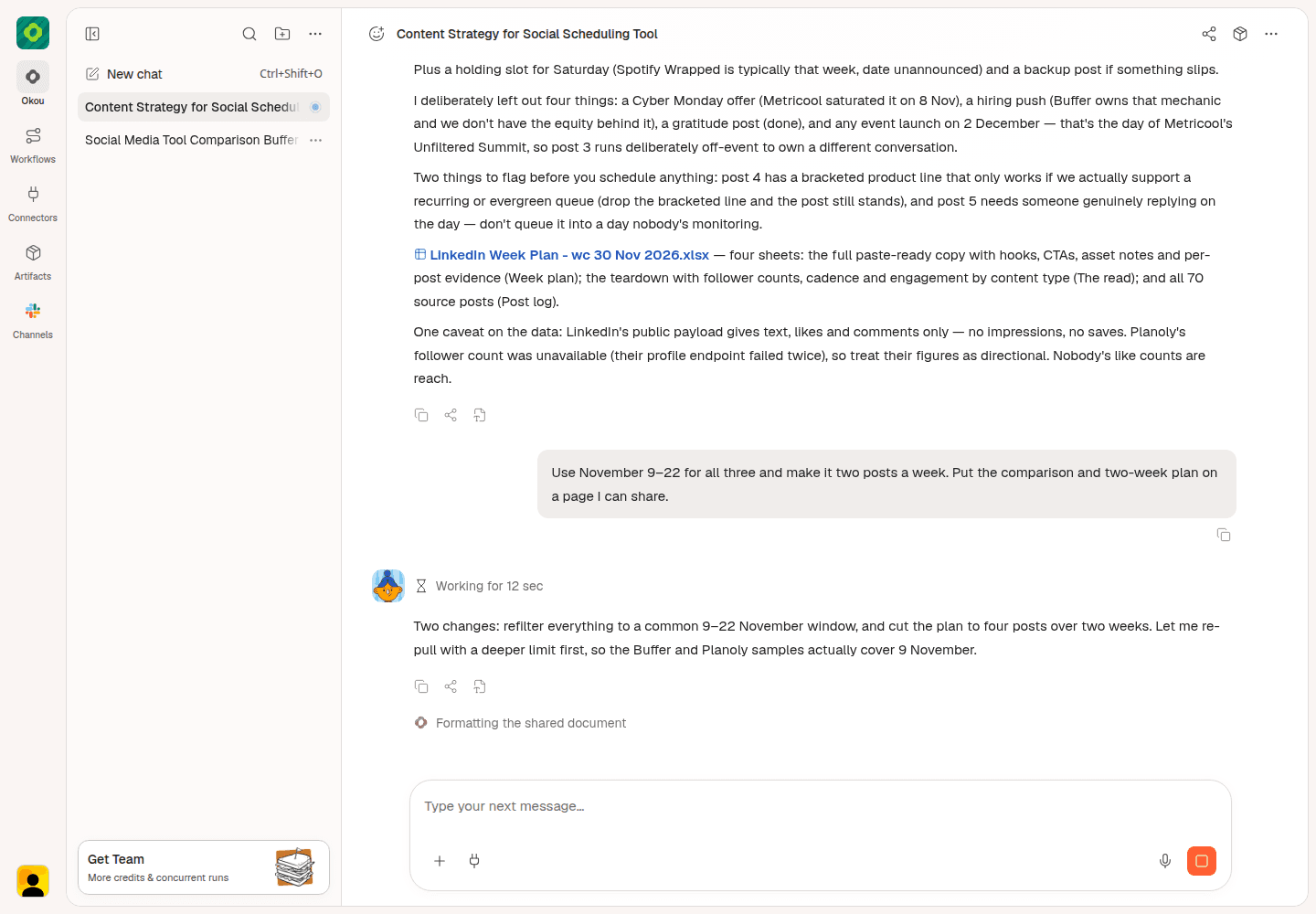
This is an intermediate draft, not the approved result. The follow-up changes the dates and production capacity; Okou then retrieves more data to cover the window.
The run initially retained 48 items from that fortnight. Review removed one duplicate Buffer newsletter item, leaving 47 in the final report.
Use the same inclusion rules for each account: platform, date window and available fields. Record the collection date too. A post's visible counters can change after you read it.
Equal dates don't guarantee complete feeds. Public retrieval was capped and inconsistent in this run. The final page labels its data as retrieved samples, not complete records. Don't turn those counts into a claim about everything a competitor published.
The final retained sample covers November 9–22, 2026 UTC, collected November 23:
| Account | Retained items | What the sample gives us | Important caution |
|---|---|---|---|
| Buffer | 31 | 21 items labeled hiring; 10 in other categories | Recruiting can dominate the apparent content mix. Authorship and reshare behavior weren't established for every item. |
| Metricool | 12 | Six items labeled event promotion, alongside other topics | One event can shape a short sample. That isn't proof of a permanent strategy. |
| Planoly | 4 | Event, customer-story, relatable and product topics | Four items are a thin sample. Its follower count was unavailable. |
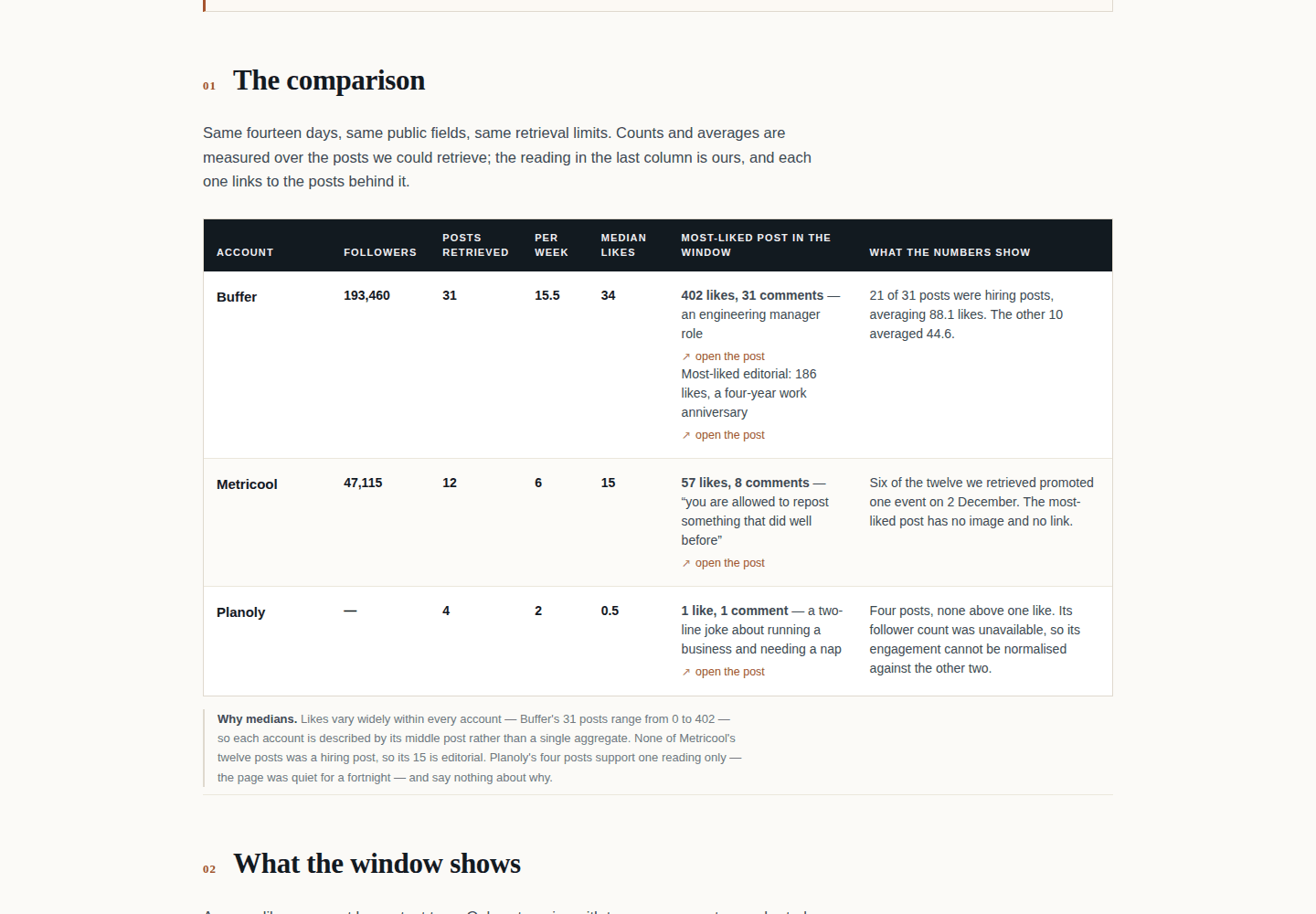
The final matrix links observations to source posts. Counts describe the retrieved sample; the full report explains missing fields and coverage limits.
The labels are interpretations of post text. They aren't categories supplied or approved by the companies.
4. Check the matrix before accepting its story
A comparison matrix should let you move from an observation back to a post. Keep the source URL beside the date, topic and visible counters. A summary without that trail is difficult to challenge.
The first report needed more work. It described a post as taking “twenty seconds to write” and called Planoly “not competing.” Neither claim followed from the data. The actual review request was:
Please remove claims we can't prove, like “twenty seconds to write” or “Planoly isn't competing.” Link the source posts and frame the gaps as ideas to test.
During that revision, the run found that returned post URLs didn't match their associated text. It rebuilt the links from each post's activity ID. The final appendix has 47 distinct post permalinks. An independent spot check against nine separately retrieved source posts matched their account labels, caption excerpts, likes and comments. That check covers nine posts, not all 47.
Further review caught an unsupported “cheapest reach” line that had survived in the proposed copy, plus an incorrect sentence comparing a median with two means. Both required another actual correction. A polished page still needs an editor.
For example, the retained Metricool reposting-advice post showed 57 likes and eight comments at collection. That supports “this post received those visible reactions.” It doesn't show how long it took to write, how many people saw it, or whether it generated customers.
Before using a comparison, check:
- Source identity: does the link open the post described? Is it the company's own post, a reshare, or an item merely associated with its feed?
- Content mix: are hiring, company culture and buyer-facing advice being treated as the same kind of content?
- Missing data: are unavailable fields marked missing rather than converted to zero?
- Inference: does the conclusion claim intent, cost or audience demand that the source cannot establish?
This run had post text, likes, comments and media-count metadata. It didn't provide impressions, saves, clicks, conversions or reliable paid-promotion information. We didn't inspect competitor comment threads or watch their videos. Raw likes across differently sized accounts aren't a winner ranking.
5. Turn observations into testable post ideas
The useful result was a set of hypotheses with source evidence and conditions that could change the recommendation.
One example: words such as “approval,” “coverage” and “escalation” didn't appear in the 47 retrieved captions. That suggests a possible operational angle for our hypothetical scheduling product. A word search doesn't establish an unmet market need. Competitors could cover the subject in images, comments, newsletters or posts the retrieval missed.
A sensible next test is a practical holiday-coverage checklist. Ask whether readers describe their own approval or coverage problems. Don't declare a market-wide content gap because a competitor didn't use your preferred keyword.
The revised output proposed these four slots:
| Proposed date | Post idea from the output | What to prepare or verify |
|---|---|---|
| December 1 | A point of view on shorter planning cycles, rather than a rigid year-long strategy | A position you can defend. Remove promises of future results unless someone owns the follow-up. |
| December 3 | A carousel about who's covering social media on December 26 | A usable coverage checklist based on a real team's process. |
| December 8 | A method for reusing a previous post | A genuine workflow and, if used, a real product screenshot. Confirm any recurring-queue feature before mentioning it. |
| December 10 | A question about a post readers would publish again | Someone available to read and answer the replies. |
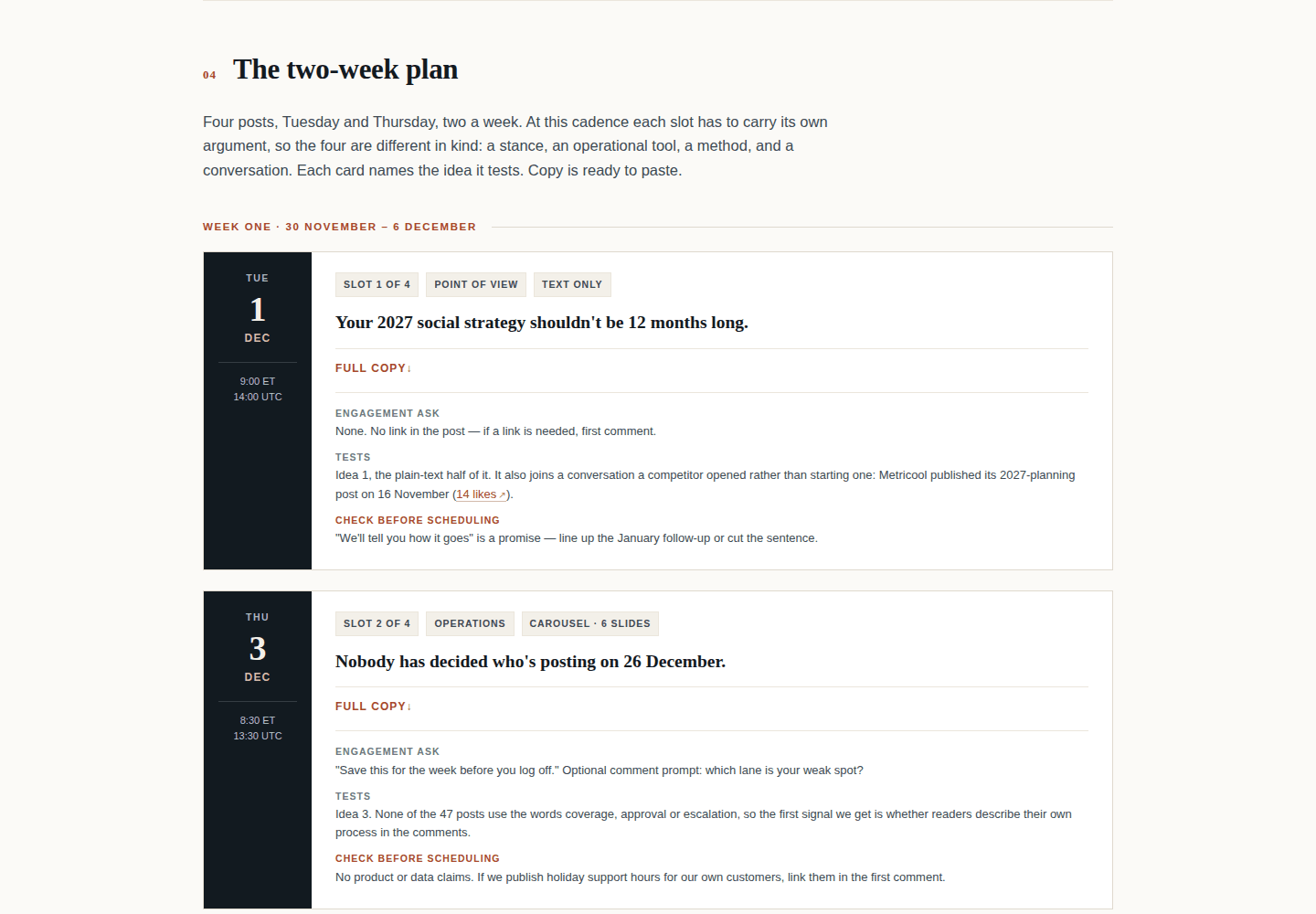
Week one of the real output. Open the report for all four proposed posts, expandable copy and source evidence; nothing was scheduled or published to social media.
The full report includes proposed copy, review cautions and the source appendix. These are drafts and suggested formats, not campaigns we published or proof that those formats will work for your account. The suggested posting times aren't validated best times for your audience.
Notice what changed when capacity became explicit. The first answer offered five main posts for one week. The revised plan contains four posts over two weeks. That is a business decision; more rows wouldn't make the plan better.
6. Add your own review and measurement
Before anyone schedules the plan, assign an owner to each post and a reviewer to each product claim. The social scheduling tool in this example is hypothetical, so its proposed product screenshot and feature references require a real business to supply evidence. Don't generate a fake interface to fill that gap.
Add a short review note to each slot:
Owner:
Asset or product proof needed:
What we want to learn:
What we'll check seven days after publishing:
This is a planning checklist, not another prompt you need to paste into Okou.
For the coverage post, you might review substantive comments about readers' processes. For a product-method post, use your own link analytics and any qualified inquiries you can actually attribute. If you have impressions, you can calculate a clearly defined rate for your own posts. The competitor sample didn't supply that denominator.
Compare with your own recent posts serving a similar purpose. Four proposed posts aren't a controlled experiment, and one quiet post doesn't prove that a topic has no demand.
Keep a record of the question, the source observation, the post you approved and what happened after publication. That gives the next comparison something better than another round of guesses.
If you later need to understand one competitor's visual choices in detail, analyze its Instagram profile and content strategy as a separate task. The cross-account matrix tells you where to investigate; a single-account review supplies depth.
Sources and limits of this example
The live report's appendix records each retained post's date, classification, likes, comments and permalink. Its method section records the common window, duplicate removal, missing fields, source-link repair and retrieval limits. Account comparability was also checked against the public Buffer, Planoly and Metricool product pages.
The screenshots and report come from the fresh short-prompt run and its real follow-ups. An earlier long-brief attempt was stopped and isn't presented here as evidence for the short prompts. No social posts were published, no private customer analytics were used, and no performance improvement is claimed.
FAQ: Social Media Competitor Analysis
How do I conduct a social media competitor analysis?
Start with a business question, such as what your team should post next. Choose comparable public accounts, one platform, a common date window and consistent sample rules. Build a comparison matrix with source links, then review source identity, missing fields and unsupported interpretations before turning observations into ideas.
Which competitors and posts should I compare?
Choose accounts serving a similar audience and use case on the same platform, and apply the same dates and inclusion rules. The English run compared Buffer, Metricool and Planoly, retaining 47 posts after duplicate removal. These were retrieved samples, not complete activity records; an empty response did not establish that an account was inactive.
Which metrics should I include?
Record each post's date, format, topic, visible likes and comments, and source URL, plus the collection date. Mark missing fields as unavailable, not zero. This run lacked impressions, so it could not calculate an impression-based engagement rate. Differences in account size and context also mean the largest like count is not a winner ranking.
How do I turn competitor research into a content plan?
Match the plan to your audience and production capacity. Connect each source-backed observation to an original angle, a draft, an owner, the asset or product proof needed, and a measurement question. This example proposed four posts over two weeks; they were drafts, not a published campaign or evidence of better results.
Can competitor analysis predict which posts will perform best?
No. Public samples may be incomplete and unrepresentative, while account size, context and unknown paid promotion affect comparisons. Likes do not establish sales or audience demand. Treat proposed angles as hypotheses, review claims before publishing, and measure your own results against recent posts with a similar purpose rather than promising a winning format.